
AUTHOR GUIDELINES
Author Guidelines
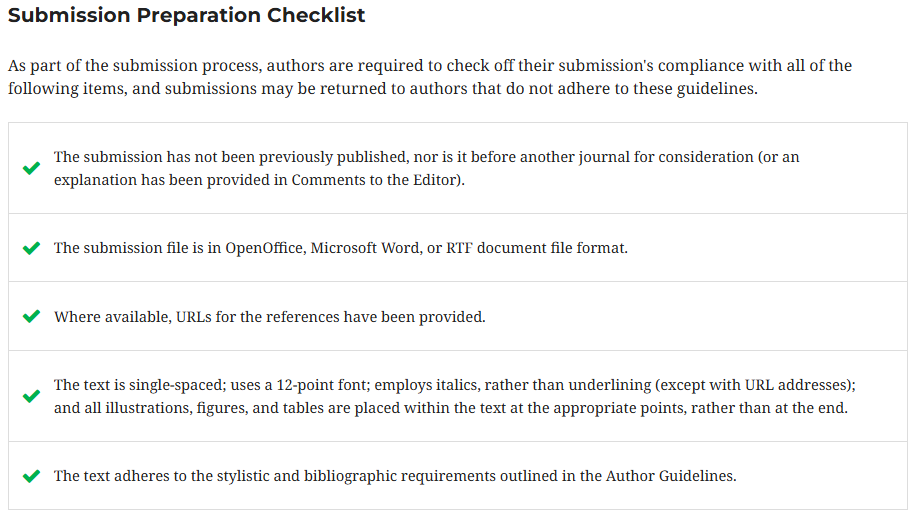
Article submitted for publication have to check to the following guidelines:
- Manuscript must use the Journal Template https://greet-research.org/index.php/Simban/index
- Manuscripts should address economic themes in general as well as economic themes in sharia;
- Manuscripts should be well written in British English or American English as well as Indonesian; therefore, using a professional proofreader is highly recommended before submission.
- Article must type in one-half spaced on A4-paper size, using Cambria font 12;
- Paper length is about 5,000-10,000 words count; thus, only manuscript following word counts length will reach the review stages;
- All submission must include a 100-350 words of abstract written in British English or American English, and also translated in Bahasa Indonesia;
- All submission must have file in OpenOffice, Microsoft Word, RTF, or WordPerfect document file format;
- Full name(s) of the author(s) must be stated, along with his/her/their institution and complete address; and the maximum additional author and co-author are 5 (FIVE)in a manuscript.
- GREET uses the American Psychological Association (APA) 7th Edition citation and reference list style for citations and references. Footnotes are required to provide additional explanations or to facilitate the tracing of specific reference sources.
- The body of article must follow standard of scientific publication, using IMRaD standard(Introduction, Methods, Results, and Discussion) and sum up with conclusion;
- The length of title is no more than 14 words.
- Regarding the diversity author policy, author or co-author who have published in an issue, their manuscript will be ONLY considered to review and may publish in the next following year.
- Manuscript thatnot obeying the author guidelines will be declined and not proceeded to next stage of review.
- The examples of footnote reference and bibliography as shown below:
Footnote:
- Stone Sweet, A. (1992). The birth of judicial politics in France: The constitutional council in comparative perspective (pp. 8–9). Oxford University Press.
- Schubert, G. (1965). The judicial mind: Attitudes and ideologies of Supreme Court justices (p. 155). Northwestern University Press.
- Kelsen, H. (1942). Judicial review of legislation: A comparative study of the Austrian and the American constitution. The Journal of Politics, 4(2), 183–200.
- Stone Sweet, A. (1992). The birth of judicial politics in France: The constitutional council in comparative perspective (pp. 37–40). Oxford University Press.
- Cartabia, M. (2007). Taking dialogue seriously: The renewed need for a judicial dialogue at the time of constitutional activism in the European Union (pp. 35–38). Jean Monnet Chair. http://www.jeanmonnetprogram.org/papers/07/071201.html
Example of References :
Stone Sweet, A. (1992). The birth of judicial politics in France: The constitutional council in comparative perspective (pp. 8–9). Oxford University Press.
Schubert, G. (1965). The judicial mind: Attitudes and ideologies of Supreme Court justices (p. 155). Northwestern University Press.
Kelsen, H. (1942). Judicial review of legislation: A comparative study of the Austrian and the American constitution. The Journal of Politics, 4(2), 183–200.
Stone Sweet, A. (1992). The birth of judicial politics in France: The constitutional council in comparative perspective (pp. 37–40). Oxford University Press.
Cartabia, M. (2007). Taking dialogue seriously: The renewed need for a judicial dialogue at the time of constitutional activism in the European Union (pp. 35–38). Jean Monnet Chair. http://www.jeanmonnetprogram.org/papers/07/071201.html
Copyright Notice
Those authors publishing in SIMBAN have agreed with following terms of conditions:
- Authors retain copyright and grant the journal right of first publication with the work simultaneously licensed under a Creative Commons Attribution-ShareAlike (CC BY-SA) License that allows others to share the work with an acknowledgement of the work's authorship and initial publication in this journal.
- Authors are able to enter into separate, additional contractual arrangements for the non-exclusive distribution of the journal's published version of the work (e.g., post it to an institutional repository or publish it in a book), with an acknowledgement of its initial publication in this journal.
- Authors are permitted and encouraged to post their work online (e.g., in institutional repositories or on their website) prior to and during the submission process, as it can lead to productive exchanges, as well as earlier and greater citation of published work.
Privacy Statement
The names and email addresses entered in this journal site will be used exclusively for the stated purposes of this journal and will not be made available for any other purposes or to any other parties.